
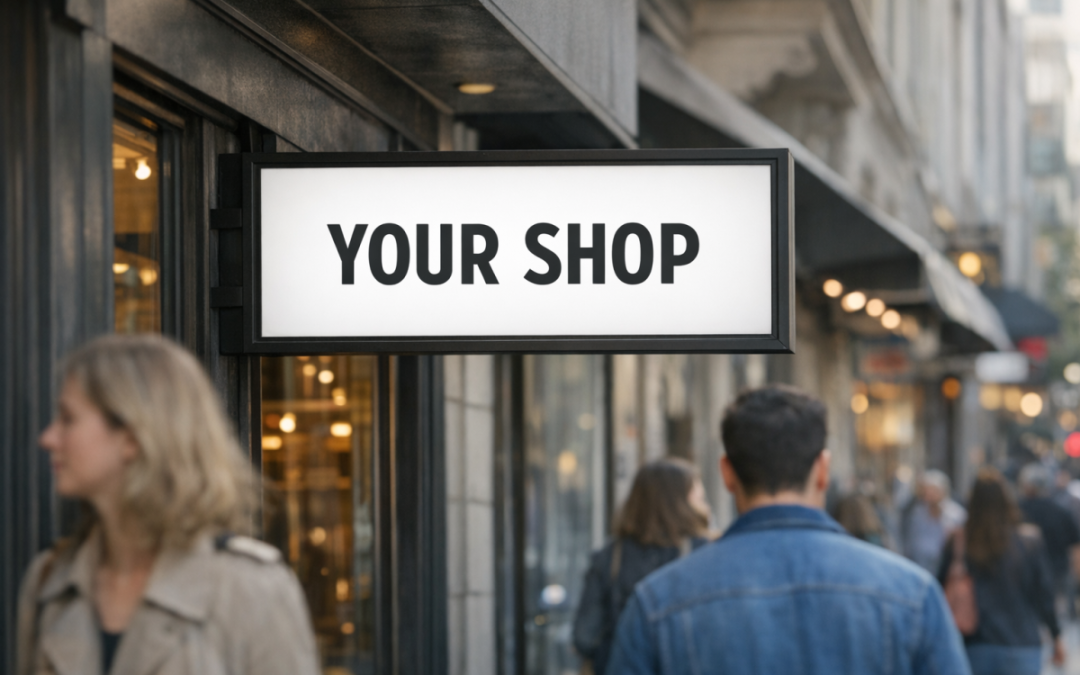
If you’ve ever stood inside your shop watching people walk or drive right past without a second glance, you already know the frustration. Maybe you’ve invested in a website, run some social ads, or leaned on word of mouth. Those things matter. But they don’t solve the immediate, physical problem of getting a person who is already nearby to step through your door; it’s where outdoor signage comes in - and it does more heavy lifting than most business owners give it credit for.
Outdoor signage is not about slapping your business name on a board and calling it a day. Done right, it functions as a silent, around-the-clock sales tool that communicates who you are, what you offer, and why they should stop - all within a matter of seconds. Studies show that well-designed exterior signage directly influences foot traffic and purchasing decisions, and for businesses on corridors like Melrose, Sunset, or Abbot Kinney, that change can be the difference between a slow month and a profitable one.
What follows is a helpful look at how outdoor signage works as a foot traffic driver in the context of Los Angeles - accounting for everything from walkable neighborhoods to high-speed boulevards - and what business owners can do to make their signage actually work for them.
Why LA’s Street-Level Competition Makes Signage a Survival Tool
Los Angeles doesn’t have one street-level environment - it has dozens. Silver Lake draws foot traffic from locals who walk to grab coffee or browse boutiques. Hollywood pulls in tourists who are actively looking for something to do. The Valley runs on cars, which means a business has maybe two seconds of visibility as drivers pass at 40 mph, and each of these settings is going to need something different from a business that wants to get seen.
That variety is what makes LA harder to get through than most U.S. cities. A strategy that works in a walkable neighborhood won’t translate to a car-dependent strip, and vice versa. Businesses that don’t account for this tend to blend into the background without realizing it.
Blending in is the problem. Bad signage doesn’t actively drive people away - it gives them no reason to stop. A stranger walking or driving past your block for the first time has no loyalty to your business and no reason to look twice unless something pulls their attention; it’s a gap that signage can fill, and it’s worth taking.
The market data has proven this too. U.S. out-of-home ad revenue reached $9.1 billion in 2024, which tells you that physical, real-world advertising is not a fading channel. Businesses are investing in it because it works at the street level in ways that online ads can’t replicate.
It’s helpful to try to actually picture your block the way a stranger would. What do they see when they approach your storefront for the first time? What stands next to you, above you, or across the street? That mental picture is where every signage choice has to start.
The Signage Formats That Actually Pull People Off the Sidewalk
Not every sign does the same job, and picking the wrong format for your location is one of the easiest ways to become invisible. The format matters as much as the message itself.
Blade signs are the workhorses of pedestrian-heavy streets like Melrose or Abbot Kinney. They extend perpendicular from a building’s face, so people walking along the sidewalk can read them from a distance without having to stop and turn. That single design choice makes them far more readable than a flat facade sign in the same location.
Window graphics and A-frames work differently - they speak to people who are already close. A well-designed window graphic can show what’s inside before anyone even reaches the door, which removes the hesitation that comes with walking past. A-frames are especially helpful for specials or limited-time information because they’re easy to update and hard to miss at eye level.
For businesses near high-traffic roads or intersections, outdoor signs carry weight. The OAAA and Harris Poll found that 76% of people who recently saw an out-of-home ad took some action afterward; it’s not a small number, and it helps explain why outdoor formats have become a smart investment for businesses that need to reach people moving through faster instead of on foot.
Murals sit in a category of their own. They don’t work like traditional signage. But a well-placed mural on an exterior wall can draw attention from half a block away and give people a reason to stop. In a city where exterior walls are basically free advertising space, that presence is hard to replicate with a standard sign.
The formats that feel invisible tend to blend into the background because they don’t create any contrast with their surroundings. Size, orientation, and lighting all play into that - which is what the next section gets into.
Placement, Visibility, and the Mistakes That Cost You Foot Traffic
Even the best-designed sign will underperform if it’s in the wrong place.
Height matters more than most business owners expect. A sign mounted too low gets hidden behind parked delivery trucks, and in Los Angeles, those trucks are everywhere. Too high, and pedestrians stop finding it because it’s outside their natural line of sight. You want to place your sign where a person walking or driving past can read it without effort.
Sun glare is one of the more frustrating problems on west-facing storefronts. In the afternoon, direct sunlight can wash out a sign’s colors - especially on glossy or backlit surfaces - making it nearly invisible during peak business hours. A matte finish or a slightly angled mount can cut back on this without a full redesign.
Font size is another area where businesses underestimate the distance factor. If someone needs to be standing right in front of your door to read your sign, it’s not doing its job. A rough guideline is that every inch of letter height can add about ten feet of readable distance from a moving vehicle.
Proximity to your entrance is also worth thinking about. A sign placed near your door can generate interest but lose the conversion if there’s no follow-through signage to guide people in. Small directional cues between your street sign and your entrance help to close that gap.
LA Sign Permits and Rules Business Owners Often Overlook
Putting up a sign in Los Angeles without the right permits can get you fines or a forced takedown.
The LA Department of Building and Safety handles sign permits for most of the city, and their rules cover everything from sign dimensions to how signs are attached to a building. It’s worth reading through their requirements before you finalize a design or hire a contractor.
Zoning is where businesses get into hot water. Different zones across the city have different rules about what types of signs are allowed, how large they can be, and whether illuminated signs are permitted at all. If your business is in a historic district or an overlay zone, the restrictions can be much stricter than the standard city rules.
Areas like Old Pasadena or parts of Hollywood have their own design review processes, and approval can take longer than a standard permit. Plan for that extra time so it does not delay your opening.
A contractor or sign company familiar with LA’s permitting process can save you time with the city. They will know what documentation to prepare and which departments to contact first.
A beautifully designed sign does nothing for your foot traffic if it gets removed before anyone sees it. Getting the legal side right from the start means your sign stays up and working for you long-term.
Your Signage Game Plan for Getting More LA Foot Traffic
A good place to start is easier than you think: walk your block as a stranger would. Approach your business from different directions, at different times of day, and ask yourself if your signage does its job. Is it visible? Readable? Does it tell newcomers what you offer and why they should stop?
When you’re ready to take that next step, the team at American Signs is here to help. If you need a fresh sign, a visibility audit, or input on what’s permitted in your area of Los Angeles, we make the process easy. Reach out for a free estimate - call us at 866-598-7271 or send us an email at info@americansignsinc.com. Your next customer might already be walking past - let’s make sure they see you.